
Prosper City Directory Sources
Prosper has no verified, continuous municipal directory run. The strongest online starting point is the University of North Texas City Directories collection, a multi-city collection with searchable text, images, advertisements, names, addresses, and phone information. Search Prosper alongside Collin County, Denton County, a surname, a street, and nearby community names. A successful result is a historical lead, not proof that the collection contains every Prosper household or every year.
| Collection | Years | Where Held | Access |
|---|---|---|---|
| UNT City Directories | Multi-city, multi-year; a Prosper run is not established | Portal to Texas History | Online search, OCR, and page images; check the image. |
| Dallas regional directory examples | 1944-45 and 1955-57 samples with Prosper references | UNT Portal | Historical regional pages, not a complete Prosper directory. |
| TSLAC directory shelf | Print and microform collection; local year range not published | Texas State Library and Archives, Austin | On-site reference use; staff do not ordinarily perform phone searches or email scans. |
| Regional newspapers and Collin Chronicles | Selected 1950s-1970s newspapers and a sampled 1999/2000 periodical | UNT Portal and library routes | Search OCR, then verify against the page image. |
The gap matters. No source located a first or last Prosper publisher year, a public reverse-directory shelf, or a Prosper-wide digital cutover. Use the collection as an evidence trail and keep the volume, page, and publication date with each result.
Prosper City Directory Regional Pages
UNT has a 1944-45 Dallas regional page that includes a PROSPER place or street entry with address lines. Related 1955, 1956, and 1957 pages provide a small year-to-year comparison. These pages show what a place-name search can uncover in a broader regional volume. They do not establish a complete town listing or show that a named person lived inside later incorporated limits.
The UNT directory collection browser is the source for the digitized collection image below.
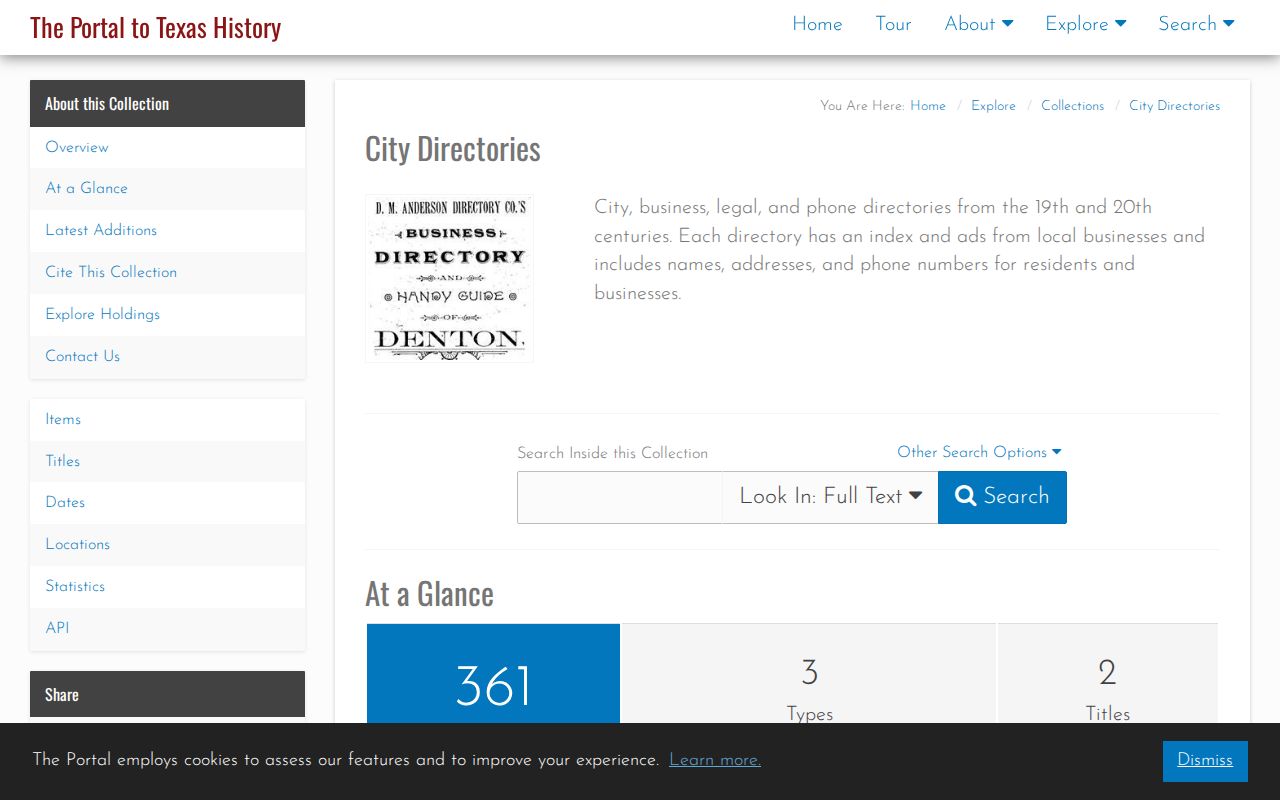
Use the collection search to find a candidate page, then open the page image and compare its heading and abbreviations with the extracted text.
In a regional directory, a Prosper reference may be a street, rural route, business mention, or cross-reference rather than a household listing. Record exactly what the page calls the place. That distinction prevents a regional hit from becoming an unsupported claim about a particular resident.
Reading Prosper City Directory Entries
A directory line needs its page header and abbreviation key. The UNT sample inventory shows searchable surname and given name, a street or place heading, address, phone, and sometimes a cross-reference or business line. Parentheses can identify a spouse, while widow or widower notation can be a useful family-history signal. The displayed image is the authority when OCR misreads initials, punctuation, or a surname.
| Identity line | Surname and given name, with initials or a cross-reference where the volume supplies one. |
|---|---|
| Household signal | Spouse in parentheses or widow/widower notation, if printed. |
| Place detail | Street, place heading, rural route, or separate address line. |
| Contact detail | Phone number when the directory included one. |
| Context detail | Business or affiliation line only as a clue for separating same-name people. |
- Criss-cross directory
- A street-ordered directory section. No verified public Prosper criss-cross shelf was located, so do not assume one exists for a year.
- Householder index
- An index organized around a household name rather than a full list of every person at an address.
- Abbreviation key
- The volume's explanation of its short labels. Photograph or cite it with the entry because a letter can change the line's meaning.
Prosper City Directory Shelf
When the online search misses a place or year, the Texas State Library and Archives city-directory guide points to a print and microform shelf in its Austin Reference Reading Room. It also directs researchers to UNT and the UT Briscoe Texas directories collection. The guide describes in-person use, not a routine phone-lookup or emailed-scan service. Bring the surname, alternate spelling, likely city or county, and the narrowest possible year range.
The Texas State Library city-directory guide is the source for this research route.
An on-site shelf is a fallback for a missed year, not confirmation that TSLAC holds a full Prosper run. Ask staff about the named volume or place, rather than requesting an open-ended search.
Prosper Historical Society Materials
The Prosper Historical Society is a human-help route rather than a searchable directory database. Collin County Historical Commission material describes a museum effort with documents, artifacts, photographs, newspaper articles, family notebooks, and Walnut Grove Cemetery care. Its materials also identify the two-volume Bill Hays history Prosper, Texas: Its History and Families. No standalone official catalog, hours, fee schedule, or searchable cemetery database was located.
The Town's resident-resources page is the verified connection to the Prosper Historical Society and other local groups.
For a family question, send the historical name, county, estimated years, and a specific source request. A narrow request helps staff or volunteers check family notebooks, newspapers, or photographs without treating private material as a current resident list.
Tracing Prosper City Directory Households
Build a household worksheet instead of merging names at first glance. The useful fields are the directory year and page, name exactly as printed, spouse or household notation, address, phone, any business line, and the source citation. Pair the nearest directory entry with the 1930, 1940, 1950, or 1960 federal census when available. Census records are household-oriented, while directories are address-oriented, so each fills a different gap.
- Search the UNT collection by surname, place name, and alternate spelling, then save the page identifier and image.
- Record the printed address or rural-route wording without modernizing it.
- Compare the next available regional directory page, keeping same-name candidates separate.
- Pair the closest released census with the directory result and compare household members and locality.
- Use a deed, probate record, obituary, or cemetery custodian to verify an important move, death, or family connection.
A disappearance can mean a move, a different spelling, an unlisted household, a change in the volume's coverage, or death. It is not enough to infer one answer from the missing line. Modern address-keyed records belong on the Prosper street directory route, not in a historical directory entry.
Prosper News Between Directories
Regional newspapers fill some of the years that a directory does not. UNT preserves the McKinney Examiner, Celina Record, and McKinney Courier-Gazette; the inspected pages include Prosper News columns and a Rhea's Mill account. Search the name with Prosper, Rock Hill, Richland, Walnut Grove, or Rhea's Mill. A notice can suggest a marriage, death, church connection, school milestone, or former address, but OCR must be checked against the scanned page.
The Prosper Community Library is a local human-help route for asking about yearbooks, microfilm, obituaries, local newspapers, and materials not described online.
Library staff can help direct a focused question, but the available research did not document a public Prosper alumni directory or official yearbook index.
Prosper Directory Place Names
Historic place words change the search. Town history identifies Rock Hill and Richland as separate communities before the 1902 railroad and post-office consolidation around the Prosper name. The Town incorporated in 1914. Older records can therefore use Rock Hill, Richland, Walnut Grove, rural-route wording, or a county name where a modern search expects Prosper. Preserve the original label first, then connect it to a present parcel only when maps, plats, and deeds agree.
That geography is especially important because current Prosper crosses Collin and Denton counties. A postal Prosper line is not proof of the historic county, municipal boundary, or legal description. The approximately 1940 Prosper map in the Texas State Archives catalog is a useful verified lead, although its inspected catalog page did not provide an image.
Note: Keep the historic place wording in the citation so a later researcher can repeat the search without projecting today's boundary onto an older record.
Prosper City Directory Limits
Historical directory entries are snapshots, not current resident verification. A person may have moved after compilation, a regional volume may have omitted the town, and a postal Prosper line can fall outside incorporated limits. The research found no evidence for a continuous Prosper-only directory sequence, no verified public reverse shelf, and no official citywide digital cutover. Treat every directory find as a dated historical source and seek a custodian record when legal proof is needed.
For records that a collection does not hold, use the responsible channel: UNT for online pages and newspapers, TSLAC for on-site directory and map research, Prosper Community Library for local-history questions, the Historical Society or Collin County Historical Commission for local materials, and the county clerk or court custodian for a certified record. This keeps a useful family-history lead separate from a claim about present residence or title.
Prosper research also has useful but limited companion sources. The Texas State Archives catalog describes an approximately 1940 Prosper map attached to 1939 fire-insurance-map context, yet its inspected catalog record did not display an image. Federal census images have a 72-year release rule, so the newest released census is not a current resident roll. Ask the library or archives for a map reproduction route, census access, or an unlisted local-history item, and retain the response with the research notes.